China Top 10 Companies That Move Heavy Equipment

Moving a 60-ton excavator or a factory press is not ordinary freight. It can require route surveys, low-bed trailers, lifting plans, and careful coordination at bridges and loading sites. For buyers comparing companies that move heavy equipment in China, the difference often lies in planning as much as vehicle size.

The World Bank’s 2023 Logistics Performance Index ranked China 19th among 139 economies, offering useful context on the country’s broader logistics environment. UNCTAD’s Review of Maritime Transport 2024 reported that global maritime trade grew 2.4% in 2023. These figures describe logistics and shipping—not heavy-haul performance specifically—so they should not be mistaken for company rankings. Still, they show why dependable connections between ports, industrial parks, and construction sites matter.

This top 10 overview considers practical factors: heavy-haul experience, equipment capacity, route-planning capability, safety practices, service coverage, and the clarity of customer communication. A polished website alone proves little. Ask how a provider handles a narrow factory gate, a low-clearance bridge, or a delayed crane booking. Small details matter. Public information can also be incomplete, and capabilities may differ by region or cargo type. Treat this list as a starting point, then verify current licenses, insurance, references, and project-specific arrangements directly with each company.
China Top 10 Companies That Move Heavy Equipment

Define Heavy Haulage Against China’s 2023 Road Freight: 40.31 Billion Tonnes

China’s road freight volume reached 40.31 billion tonnes in 2023. That figure describes the wider freight market, not heavy equipment alone. It includes many kinds of cargo moving through a vast network of roads. A national total is useful context. It is not a heavy-haul measure.

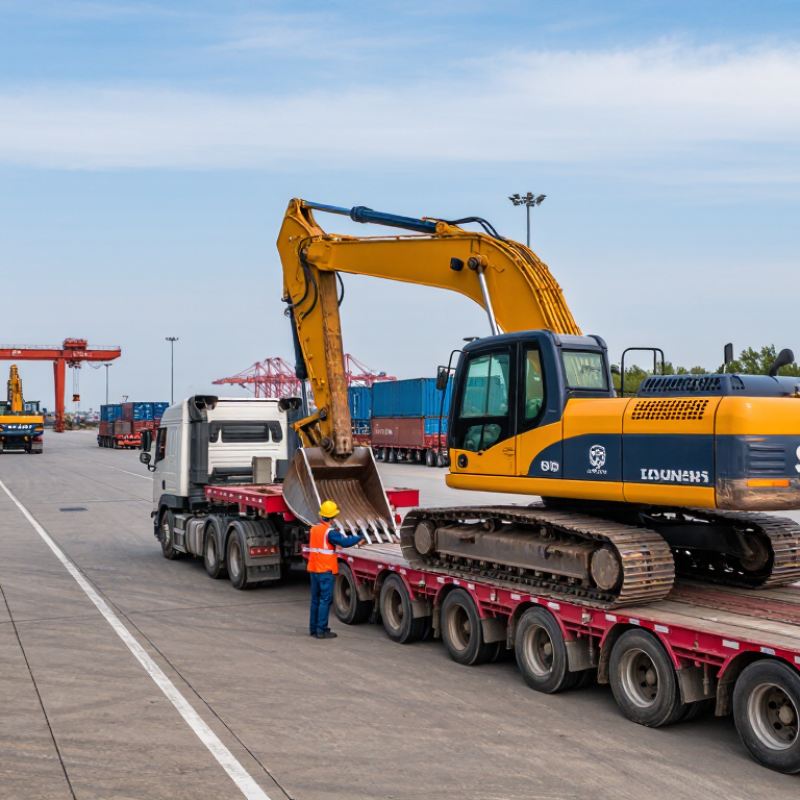
Heavy haulage is defined by the demands of a specific load. An excavator’s weight, width, and height can affect which vehicle and route are suitable. So can bridge clearances, road surfaces, and access to the worksite. A low-loader may carry the machine, while support vehicles help manage a tight turn or narrow entrance. Small details matter.

The 40.31-billion-tonne figure shows the scale of road transport, but it cannot identify specialist capability by itself. When comparing heavy-equipment movers, customers can look for clear load assessments, route planning, suitable trailers, and communication about timing. Ask how site access will be checked. Ask what information is still uncertain. A large national statistic does not guarantee an easy delivery, and even a careful plan may need revision when conditions change.

Explain GB 1589-2016: Six-Axle Vehicle Combinations Have a 49-Tonne Limit

Under GB 1589-2016, a six-axle vehicle combination has a maximum gross mass of 49 tonnes. Gross mass includes the tractor, trailer, fuel, equipment, and cargo—not cargo alone. The standard also sets axle-load and dimension limits, so meeting the total-mass cap is not enough. A load concentrated over one axle can still exceed its individual limit.

The Ministry of Transport’s 2023 Statistical Bulletin records 40.3 billion tonnes of road freight in China, showing the scale of road logistics. But that national figure does not make every six-axle configuration suitable for every heavy load. Before dispatch, operators should confirm axle count, axle spacing, actual loaded mass, and the applicable route requirements. Weighing each axle group is more useful than relying on a cargo estimate. Small differences matter.

Tips: Check the vehicle plate and weigh the loaded combination. Leave a margin below 49 tonnes; payload calculations can miss fuel, tools, and securing equipment. The standard is a baseline, not a route-specific clearance.

Set Ranking Criteria: Fleet Scale, Permits, Safety, Routes, and Project Record

A useful ranking of China’s heavy-equipment movers should measure more than fleet size. Count suitable tractors, trailers, and lifting systems, then check whether equipment is maintained and available for demanding jobs. Numbers need context. A large fleet can still have limited capacity for a specific load.

Permit capability and route planning deserve separate scores. Review how teams assess bridge limits, road width, turning space, and overhead clearance before dispatch. Ask whether permit applications and route checks are documented for each project. Plans change. A reliable operator should explain how it handles roadworks or weather delays, rather than treating the original route as fixed.

Safety records should include training, equipment inspections, incident reporting, and corrective actions. Compare consistent reporting periods, not isolated claims. Project experience also matters: examine completed moves by load weight, distance, complexity, and delivery record. Where possible, verify details through project documents or client references. No scoring model is perfect; public data may be incomplete, and self-reported figures need careful review. State the evidence behind each score, note missing information, and avoid treating a polished fleet photograph as proof of performance.

Profile 10 Chinese Heavy-Equipment Movers by Services and Regional Coverage

China’s heavy-equipment movers differ in the routes and services they cover. A useful ten-company profile should make those differences clear, not rely on broad claims. One operator may focus on coastal port transfers; another may serve manufacturing clusters in eastern China. A third may coordinate moves along the Yangtze corridor. Coverage varies.

Other profiles might highlight northern industrial routes, western inland destinations, or cross-province transport planning. Some operators specialize in low-bed trailer moves for excavators and presses. Others bring cranes, lifting crews, or modular trailers for oversized loads. A plant-relocation provider may handle packing, loading, and on-site positioning. A project coordinator may arrange multiple carriers across regional networks. These are service distinctions, not proof that every provider serves every province.

For each profile, readers should check equipment limits, route-survey methods, and stated service areas. Ask whether a quoted route includes bridge checks, loading, escorts, and delivery coordination. A map can look impressive and still hide gaps. Real coverage may depend on cargo dimensions, road access, and seasonal conditions. I would also verify how clearly an operator explains delays; polished claims alone are not enough.

China: 10 Heavy-Equipment Mover Profiles — Services and Regional Coverage

These are anonymized, generalized service profiles—not a verified ranking or company-specific directory. Services and geographic reach vary by operator, cargo, permits, route conditions, and project requirements. Confirm capabilities directly with a qualified carrier.

Profile Typical Cargo Focus Typical Services Typical Regional Coverage Key Planning Considerations
01 Wind-turbine components, including long blades and tower sections Oversize road transport; route surveys; specialized trailers; loading and unloading coordination; escort arrangements where required Wind-project corridors in northern and northwestern China, with project-based connections to ports and inland sites Blade length, turning radius, overhead clearance, road geometry, and site access
02 Power transformers, generators, and other high-weight electrical equipment Heavy-haul transport planning; axle-load configuration; lifting coordination; temporary road or bridge assessments; multimodal transfer planning Industrial and power-project routes across eastern, central, and northern China Gross weight, axle loads, bridge capacity, transformer dimensions, and lifting points
03 Construction machinery, such as excavators, cranes, and loaders Low-bed trailer transport; equipment loading and securing; regional site delivery; dispatch coordination Major construction markets and transport corridors in eastern, central, and southern China Machine dimensions, operating weight, track or tire condition, and loading-ramp requirements
04 Mining and quarry equipment, including large structural and mobile units Heavy and oversize road movements; modular trailer planning; route reconnaissance; mine-site delivery coordination Mining areas in northern, northwestern, and southwestern China, subject to route and site access Remote-road condition, gradients, seasonal access, turning space, and bridge restrictions
05 Factory machinery, production lines, and industrial modules Factory-to-site relocation; packing and lifting coordination; staged transport; road, rail, or waterway options where suitable Manufacturing clusters in the Yangtze River Delta, Pearl River Delta, and central China Disassembly needs, cargo center of gravity, indoor access, delivery sequence, and installation schedule
06 Oil, gas, and petrochemical project equipment, including pressure vessels and process modules Project cargo planning; oversize road transport; port-to-site coordination; lifting and temporary storage arrangements Coastal industrial bases and selected inland energy-project corridors Permit lead times, cargo dimensions, port handling limits, route clearances, and site delivery windows
07 Shipyard, port, and marine-project equipment Port and yard transfers; heavy lifting coordination; short-distance heavy haul; barge or vessel interface planning where appropriate Coastal port regions, including northern, eastern, and southern China Quay capacity, tidal or vessel schedules, lifting capacity, and coordination between road and marine operations
08 Railway, tunnel, and large civil-engineering equipment Low-bed or modular trailer transport; construction-site delivery; route and access checks; equipment relocation support Infrastructure project corridors across eastern, central, and western China Tunnel and bridge clearances, worksite access, road closures, and movement timing
09 Very heavy or indivisible cargo requiring specialized transport engineering Hydraulic modular trailer planning; axle-line calculations; engineering review; route surveys; coordinated lifting and movement plans Project-specific routes connecting industrial facilities, ports, and major construction sites nationwide Load distribution, structural route limits, turning geometry, permits, and escort requirements
10 Oversized cargo moving between inland production sites and seaports Road-and-waterway or road-and-rail coordination; port handling; temporary storage; export shipment interface planning Inland manufacturing regions linked to coastal gateways in northern, eastern, and southern China Intermodal handling limits, terminal access, cargo dimensions, shipping cutoffs, and securing requirements

Compare Oversize-Load Planning, Escort Requirements, and Delivery Capabilities

When comparing China’s heavy-equipment transport companies, look beyond quoted prices. Oversize-load planning should begin with the machine’s dimensions, weight, center of gravity, and loading method. A capable planner checks bridge limits, road width, turning space, overhead cables, and access at the destination. Ask for a written route assessment, not just a promised delivery date. Details matter.

Escort requirements depend on the load, route, and local approvals. Providers should explain who arranges escorts, how route changes are handled, and what happens if weather or traffic disrupts the journey. Requirements can vary, so confirm them with the carrier and relevant authorities before dispatch. Clear answers are reassuring. Vague assurances are not.

Delivery capability also means having suitable trailers, secure loading procedures, and realistic schedules. Compare whether a company can coordinate collection, transit updates, unloading, and final-site access as one service. Ask how it protects exposed components from rain and road debris, and request recent examples of similar moves. A polished plan can still miss a tight gate or soft ground. That deserves a second look.

China Top 10 Companies That Move Heavy Equipment

Oversize-load planning, escort requirements, and delivery capabilities — regulatory planning baselines for China

The chart shows China’s highway over-limit thresholds for the combined vehicle-and-cargo envelope: width over 2.55 m, height over 4.0 m, or length over 18.1 m. Exceeding a threshold can require an over-limit transport permit and route review. Escort needs and delivery feasibility depend on the load, vehicle configuration, route, and permit conditions; they are not uniform company-level figures. These regulatory benchmarks are provided instead of unverified rankings or company-specific data. Reference: China’s Ministry of Transport, Measures for the Administration of Highway Over-limit Transportation.