
Top 10 Power Bank Rental Business Suppliers

A Power Bank Rental Business can look simple from the street: a compact kiosk, a phone, and a charged battery. Behind that quick exchange sits a demanding operation. Suppliers shape the station’s reliability, software stability, payment flow, maintenance needs, and customer support. A device that fails during a busy evening can cost more than one rental. It can also weaken trust.

This guide examines ten suppliers through practical criteria: station design, battery capacity, app experience, remote monitoring, service coverage, and partnership terms. Management thinker Peter Drucker offered a useful customer-focused principle: “The aim of marketing is to know and understand the customer so well the product or service fits him and sells itself.” For rental operators, that means checking real user needs, not just comparing glossy product images. Can a visitor find a station near a restaurant entrance? Is the return process clear? Does support respond when a dock stops charging?

Small details count. Supplier claims deserve careful checking against references, demonstrations, and service commitments. A low purchase price may hide higher maintenance costs. A polished dashboard may not guarantee smooth field operations. There is no perfect supplier for every market, and this comparison cannot replace local testing. Use it as a starting point for informed questions, realistic cost estimates, and a pilot that reveals what works before wider deployment.
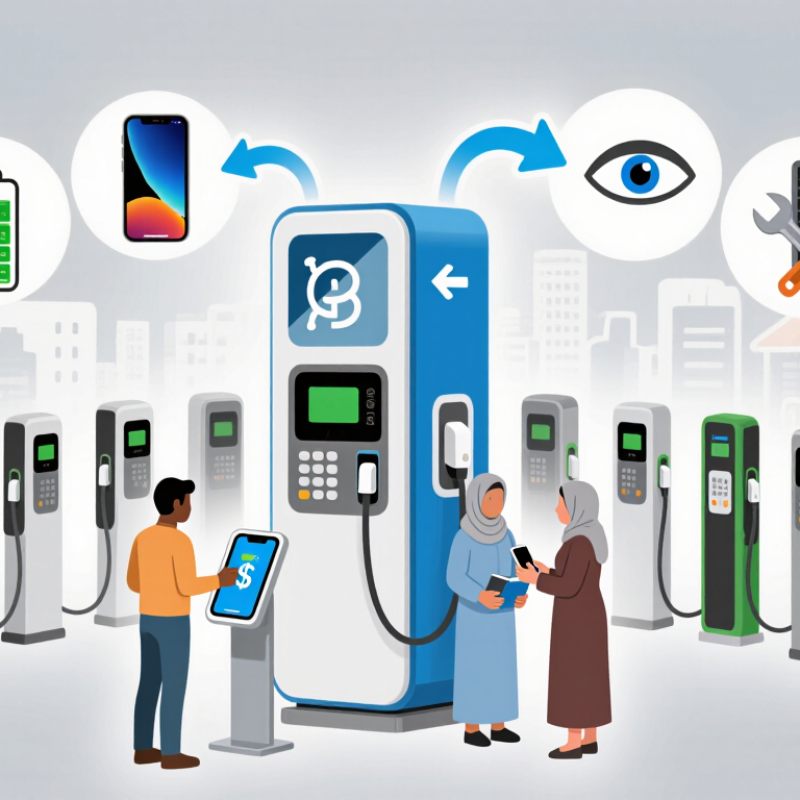
Top 10 Power Bank Rental Business Suppliers

Power Bank Rental Suppliers: Business Models, Stations, and Revenue Metrics

Power bank rental suppliers generally use three models: pay-per-use, membership plans, or venue-based revenue sharing. Pay-per-use suits transit hubs and cafés, where visitors need a quick charge. Memberships can encourage repeat use, but only when stations are easy to find and returns are convenient. Revenue-sharing lets venues host stations with less upfront investment. Clear terms matter.

Demand is tied to everyday phone use, not just travel. GSMA’s 2024 State of Mobile Internet Connectivity Report estimated that 4.6 billion people used mobile internet in 2023. Grand View Research valued the global power bank market at about US$13.4 billion in 2023; that figure covers power banks broadly, not rental services alone. Small details matter. A station beside a checkout may outperform one hidden down a hallway.

Compare suppliers using rentals per station per day, average rental duration, return rate, and revenue after venue commissions. Track peak-hour availability, too: an empty station during lunch can lose more than one quiet overnight period. Ask how suppliers monitor battery health and replace damaged units. One caveat: high rental counts do not guarantee profit if commissions, service visits, and lost inventory are overlooked. Metrics need context.

How to Rank the Top 10: Fleet Size, Uptime, Coverage, and Utilization

A credible ranking of power bank rental suppliers should measure operating strength, not just advertised station counts. Fleet size matters because more active stations can improve access, but only when devices are actually deployed and maintained. We would check installation records, active inventory, and recent expansion data. A large fleet with many idle units can look impressive on paper. It tells only part of the story.

Uptime deserves close attention. Compare station availability using timestamped service logs, and separate brief outages from repeated failures. A station showing as available in an app may still have empty bays, so field checks add useful context. Coverage should be judged by how well stations serve practical locations, such as transit hubs, shopping areas, and event venues. A map full of pins is not enough if entire neighborhoods remain unserved. Not perfect.

Utilization shows whether customers use the network. Review rentals per station, return rates, and seasonal changes over several months. Very high utilization may signal strong demand, but it can also mean too few batteries during busy hours. Low utilization needs context: a newly opened site may simply need time. Rankings should disclose their measurement periods and data gaps. That transparency is easy to overlook, and it can change the order.

Top 10 Supplier Profiles: Networks, Charging Capacity, and Target Markets

A useful review of ten power bank rental supplier profiles starts with network shape. A dense city network suits commuters who need a unit near stations, cafés, and office blocks. Airport-focused operators need dependable access across terminals and longer opening hours. Shopping-centre providers benefit from visible kiosks near food courts and entrances. Campus suppliers should cover libraries, lecture halls, and student residences. Event-focused networks need portable stations and enough inventory for sudden crowd surges. Placement matters.

Charging capacity deserves more than a headline figure. Check how many devices each station can serve, how quickly units recharge, and whether staff can replace depleted stock. Hotel-oriented suppliers may prioritize overnight availability and simple guest instructions. Transit networks need compact stations that fit busy concourses. Tourism-focused services benefit from multilingual prompts and convenient return points. Retail partnerships can increase visibility, though a kiosk hidden behind a checkout may see little use. Regional providers may offer closer support, but their coverage can be uneven. That is worth checking. Compare live station maps, maintenance response times, and reported availability across ordinary weekdays and peak periods. Numbers alone can mislead; a large network is less useful when its busiest locations are often empty.

Battery Safety Benchmarks: IEC 62133-2 and IATA’s 100 Wh Baggage Threshold

For power-bank rental operators, battery safety starts before a unit reaches a kiosk. IEC 62133-2:2017+A1:2021 sets safety requirements and tests for portable sealed lithium cells and batteries. Its test scope includes vibration, mechanical shock, external short circuit, and thermal abuse. These checks matter when devices are dropped, charged overnight, and moved between outlets. A certificate alone is not a complete operating control. Keep model-level test records, supplier declarations, and batch traceability together. Inspect swelling, casing seams, and warm connectors during routine returns.

IATA’s 2025 passenger baggage guidance uses 100 Wh as a key threshold: power banks up to 100 Wh are generally permitted in cabin baggage; units from 100 to 160 Wh require airline approval. Carrier rules may be stricter. For rental fleets, clear Wh labels can reduce airport confusion. Calculate watt-hours by multiplying voltage by amp-hours; divide milliamp-hours by 1,000 first. Keep it visible. A 20,000 mAh pack rated at 3.7 V holds about 74 Wh, not 20,000 Wh. Capacity can change with age, and labels are not always consistent. That gap deserves regular auditing.

Top 10 Power Bank Rental Business Suppliers - Battery Safety Benchmarks: IEC 62133-2 and IATA’s 100 Wh Baggage Threshold

A non-branded procurement scorecard for comparing rental-business suppliers. These are screening criteria, not a ranking of named companies. Confirm current airline, regulatory, and local requirements before purchase or transport.

No. Supplier Capability to Assess Evidence to Request Safety Benchmark Rental-Business Check
1 Battery safety documentation Test report or certification documentation identifying the exact cell or battery model used in the power bank. Check applicability of IEC 62133-2, which specifies safety requirements and tests for portable sealed secondary lithium cells and batteries under intended use and reasonably foreseeable misuse. Match the documented model to the battery installed in every device configuration being offered.
2 Transport-test documentation UN 38.3 test summary for the relevant lithium battery type, with model identification and test-laboratory details. Lithium batteries offered for transport are subject to applicable UN Manual of Tests and Criteria, subsection 38.3 requirements. IEC 62133-2 does not replace UN 38.3 transport testing. Request updated documents when battery design, cell type, or manufacturing source changes.
3 Rated energy and capacity labeling Product label and technical sheet showing rated voltage, capacity in ampere-hours or milliampere-hours, and watt-hours. Watt-hours can be calculated as: Wh = nominal voltage (V) × capacity (Ah). For example, 3.7 V × 20 Ah = 74 Wh. Use the rated Wh value—not only the mAh figure—for aviation screening and inventory records.
4 Air-travel threshold awareness Written handling guidance for staff and customers carrying power banks on passenger aircraft. Power banks are treated as spare lithium batteries: they must be carried in cabin baggage, not checked baggage. Up to 100 Wh is generally permitted without airline approval; above 100 Wh and up to 160 Wh generally requires airline approval and is limited to two spare batteries per passenger. More than 160 Wh is not permitted in passenger baggage. Airline rules can vary. Provide clear customer instructions and direct travelers to confirm rules with their airline before departure.
5 Battery protection and electrical design Technical description of the battery-management and protection circuitry, including overcharge, over-discharge, overcurrent, and short-circuit protections where applicable. Protection features should be documented for the offered design; their presence does not by itself establish compliance with a safety standard. Confirm protection behavior for the supplied battery, charging input, and output ports.
6 Cell and batch traceability Records linking battery model, production batch, manufacturing date, and finished power-bank units. Traceable identification supports incident investigation, targeted quarantine, and recall actions; it is not a substitute for safety testing. Check that returned units can be linked to a batch or serial-number record.
7 Charging system compatibility Input ratings, supported charging protocols, charger specifications, and instructions for approved charging accessories. Charging equipment must be used within the power bank’s stated input ratings. Do not assume that a connector type alone confirms compatibility. Assess whether the charging setup supports the expected fleet volume without exceeding the documented ratings.
8 Inspection and damaged-unit process Inspection checklist and written procedures for swollen, leaking, unusually hot, damaged, or recalled units. Damaged or defective lithium batteries can present fire risks and should not be treated as ordinary reusable stock or transported without appropriate guidance. Verify that staff can isolate suspect units and escalate them through a documented process.
9 Charging-station and fleet support Station specifications, installation instructions, maintenance guidance, and service-response terms. Check station electrical ratings and the supplier’s documented operating conditions; no single station capacity or service level is a universal safety standard. Compare compatibility with the planned site layout, usage pattern, and maintenance resources.
10 Ongoing compliance and change control Revision-controlled product specifications, change notices, warranty terms, and a process for reporting safety issues. Confirm that documentation remains applicable after changes to cells, battery packs, electronics, or manufacturing sites. Make advance notification of safety-relevant product changes part of the purchasing agreement.

Reference points: IEC, IEC 62133-2; IATA, Lithium Batteries; UN Manual of Tests and Criteria. Always verify the latest applicable rules with the relevant authority and airline.

Supplier Comparison: Pricing, Roaming, APIs, and Service-Level Metrics

Compare suppliers on the full cost per rental, not just the kiosk price. Ask for hardware, software, payment, maintenance, and revenue-share fees in writing. A low monthly rate can hide expensive repairs or minimum-volume clauses. For roaming, test whether one user account and payment method work across locations, currencies, and partner networks. GSMA’s Mobile Economy 2024 report estimates 5.6 billion unique mobile subscribers worldwide in 2023, about 69% of the population. That scale makes cross-location access valuable, but it does not prove a supplier’s roaming works smoothly. Test it.

API quality needs evidence. Request sandbox access, documentation, webhook examples, versioning rules, and a named support contact. Check whether rental status, battery inventory, refunds, and station outages update reliably. Compare service-level metrics such as monthly uptime, incident response time, repair turnaround, and replacement-stock availability. Ask how each metric is measured, and what happens when targets are missed. A dashboard alone is not a guarantee.

Tips: Run a small pilot at busy and quiet sites. Record failed unlocks, empty slots, refund delays, and support response times. Compare actual results with contract terms. One detail is easy to overlook: a fast response time means little if replacement parts take days to arrive. Build a simple scorecard, but leave room for judgment; real-world traffic is uneven, and no supplier’s estimate will fit every venue.

Suggested evaluation weighting for comparing power bank rental suppliers. These percentages are a decision-making framework, not supplier-reported results. Apply the same criteria to each supplier’s current proposal and service documentation.