
China Best Ceramic Laser Reflectors Supplier?

Finding the China Best Ceramic Laser Reflectors Supplier? The answer depends on your laser system, not marketing language. Ceramic Laser Reflectors must match wavelength, beam power, reflector geometry, thermal load, and mounting conditions. A reflector that performs well at 1,064 nanometers may fail under ultraviolet exposure. Small details matter. Surface roughness, coating adhesion, pore structure, and edge quality can change beam stability.

Laser pioneer Theodore Maiman once said, “The laser is a solution looking for a problem.” His words remain useful here. The right reflector should solve a defined engineering problem, rather than simply carry an impressive specification. Experienced suppliers should provide material data, coating options, dimensional tolerances, and test results. Ask about laser-induced damage threshold testing, preferably referencing recognized methods such as ISO 21254. Request sample inspection reports. Check whether values apply to your wavelength and pulse duration.

This guide examines Chinese manufacturers through practical evidence. It considers alumina, beryllia alternatives, zirconia, and other technical ceramics. It also reviews thermal expansion, dielectric behavior, production consistency, and quality control. A polished catalog is not enough. Factory experience matters. So does communication during design changes.

No supplier is perfect. Some companies offer excellent machining but limited coating expertise. Others provide strong coatings but weak documentation. That trade-off deserves attention. Buyers should compare samples, test procedures, lead times, and after-sales support. The strongest choice is the supplier that can explain its limits clearly. Reliability begins there.
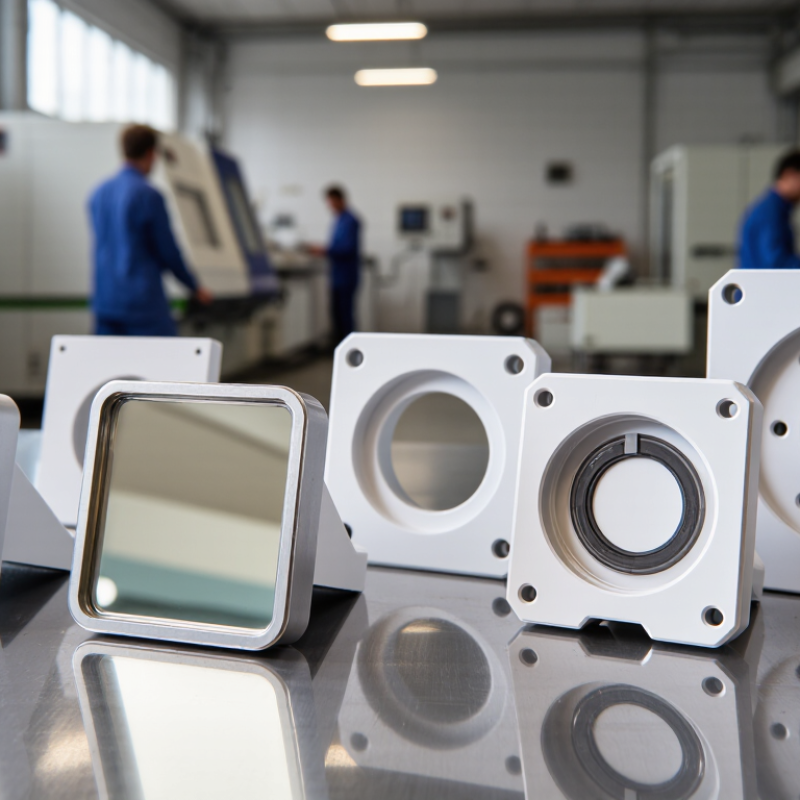
China Best Ceramic Laser Reflectors Supplier?

Ceramic Laser Reflectors: Types, Materials, and Key Optical Data

Ceramic laser reflectors are not one universal product. Common types include diffuse reflectors, specular reflectors, and custom-shaped reflector cavities. Alumina offers strong thermal stability and broad availability. Zirconia provides higher toughness and controlled surface quality. Beryllia can conduct heat efficiently, but it requires strict handling controls. Porous white ceramics often scatter light, while dense, polished ceramics support more directional reflection.

Optical data must match the laser wavelength. Typical specifications include reflectance, scattering, absorption, surface roughness, thermal expansion, and maximum operating temperature. In many visible and near-infrared systems, engineered white ceramics can deliver over 90% diffuse reflectance, but the value changes with porosity and measurement geometry. A single reflectance number is not enough. The test wavelength matters. So does the incident angle. Grand View Research’s 2024 laser technology report estimated the global market at about USD 19.8 billion in 2023, with strong growth through 2030. This expansion increases demand for repeatable optical ceramics.

When evaluating a China ceramic laser reflector supplier, request wavelength-specific test data, dimensional tolerances, coating details, and thermal-cycle results. ISO 10110 optical documentation can improve drawing clarity and inspection consistency. Ask whether reflectance was measured using an integrating sphere or a directional setup. These methods can produce different results. I would also check batch variation, because laboratory samples may look better than production parts. That shortcut often fails. A reliable supplier should provide traceable reports, sample approval, and realistic performance limits rather than impressive but incomplete figures.

China Best Ceramic Laser Reflectors Supplier? - Ceramic Laser Reflectors: Types, Materials, and Key Optical Data

Reflector Type Typical Ceramic Material Common Wavelength Range Typical Reflectance Reflectance Mode Typical Surface Finish Thermal Conductivity Coefficient of Thermal Expansion Typical Operating Considerations
Diffuse cavity reflector High-purity porous alumina, Al2O3 ≥ 99% 400–1,100 nm 90–98% at 532–1,064 nm Diffuse hemispherical reflection Matte, porous, or micro-textured surface 3–15 W/m·K 6.5–8.5 × 10⁻⁶/K Widely used for flashlamp and diode-pumped cavities because of its high whiteness, electrical insulation, and good temperature resistance.
Dense ceramic reflector Dense alumina, Al2O3 ≥ 99.5% 400–1,100 nm 80–95% at 532–1,064 nm Diffuse to semi-diffuse reflection Ground, lapped, or glazed 20–35 W/m·K 7.0–8.5 × 10⁻⁶/K Provides improved mechanical strength and thermal conduction compared with porous alumina; reflectance depends strongly on porosity, color, and surface treatment.
White yttria reflector Yttria, Y2O3 ≥ 99.9% 400–2,000 nm 85–96% at 1,064 nm Diffuse reflection Fine-grained matte or polished and coated 8–15 W/m·K 8–11 × 10−6/K Useful when low optical absorption and high-temperature chemical stability are required; mechanical shock resistance is lower than that of alumina.
High-temperature zirconia reflector Stabilized zirconia, ZrO2 400–2,000 nm 75–92% at 1,064 nm Diffuse reflection Matte, textured, or glazed 2–3 W/m·K 9–11 × 10−6/K Offers high fracture toughness and low thermal conductivity; thermal-gradient design and mounting are important because of its relatively high expansion coefficient.
Thermally conductive ceramic reflector Beryllium oxide, BeO 400–1,100 nm 85–96% at 532–1,064 nm Diffuse reflection Matte or micro-textured 200–330 W/m·K 7.5–8.5 × 10⁻⁶/K Combines high thermal conductivity with electrical insulation. Beryllium-containing dust is hazardous, so machining and handling require strict industrial controls.
Dielectric-coated ceramic mirror Polished alumina or fused ceramic substrate with multilayer dielectric coating 355, 532, 633, 808, 915, or 1,064 nm 99.0–99.9% at the design wavelength Specular reflection Polished; typical surface roughness Ra ≤ 10 nm 20–35 W/m·K for alumina substrate 7.0–8.5 × 10⁻⁶/K for alumina substrate Provides high reflectivity and low scatter at a specified angle of incidence. Coating bandwidth, laser-induced damage threshold, and environmental durability must be specified separately.
Metal-coated ceramic mirror Polished alumina substrate with protected aluminum or silver coating 450–2,000 nm 90–98%, depending on metal and wavelength Specular reflection Polished; protected surface coating 20–35 W/m·K for alumina substrate 7.0–8.5 × 10⁻⁶/K for alumina substrate Offers broad spectral coverage, but coating absorption, oxidation resistance, humidity resistance, and laser damage threshold require application-specific qualification.
Glazed ceramic reflector Alumina or zirconia body with white oxide glaze 400–1,100 nm 85–97% at 532–1,064 nm Diffuse or semi-diffuse reflection Smooth glazed surface 2–20 W/m·K, depending on body and glaze 6.5–11 × 10−6/K Provides a cleanable, chemically resistant surface. The glaze and ceramic body should have compatible thermal expansion to reduce crazing or delamination.
Engineering note: The optical values are representative ranges for material and surface classes, not guaranteed product specifications. Reflectance varies with wavelength, angle of incidence, polarization, porosity, grain size, coating design, surface contamination, and measurement geometry. For laser use, confirm total hemispherical or specular reflectance, absorption, scatter, surface roughness, coating durability, and laser-induced damage threshold using the exact operating wavelength and power density.

Reflectance at 1064 nm and 10.6 μm: Comparing Ceramic Performance

China Best Ceramic Laser Reflectors Supplier?

Reflectance at 1064 nm and 10.6 μm: Comparing Ceramic Performance

Ceramic laser reflectors should be judged at the working wavelength, not by appearance alone. At 1064 nm, surface polish, porosity, and impurities can strongly influence reflected power. A dense, finely finished ceramic may provide stable reflection for near-infrared laser systems. However, small surface defects can scatter the beam and create local heating.

The result changes at 10.6 μm. Infrared absorption, thermal expansion, and crystal structure become more important. Some ceramics remain stable under continuous carbon-dioxide laser exposure, while others absorb excessive energy. Reflectance values must come from measurements near 10.6 μm, preferably using calibrated infrared equipment. Data from visible or near-infrared testing is not enough.

Test conditions matter greatly. Confirm the incidence angle, beam size, surface roughness, temperature, and measurement uncertainty. A supplier should provide batch-level reflectance data, dimensional tolerances, thermal-cycle results, and inspection records. Check both wavelengths separately. One coating or finish rarely performs equally well across this range.

A practical mistake is trusting one impressive laboratory number. Real assemblies face dust, vibration, repeated heating, and imperfect alignment. I would request samples before volume purchasing. Inspect the reflector after cycling, not only before testing. Even a small color change or edge crack deserves investigation. Supplier reliability also depends on traceable materials and consistent process control.

Ceramic Laser Reflectors: Representative Reflectance at 1064 nm and 10.6 μm

This comparison uses representative diffuse-reflectance values for common technical ceramics under comparable polished-surface conditions. White alumina and boron nitride generally provide stronger broadband reflection, while silicon carbide absorbs more energy at both laser wavelengths. Actual performance depends on purity, porosity, surface finish, grain structure, angle of incidence, and measurement method; the values shown are engineering reference figures rather than product specifications.

Thermal Ratings, Porosity, and Surface Roughness in Laser Reflectors

When evaluating a China-based ceramic laser reflector supplier, thermal ratings deserve careful verification. A reflector may tolerate high temperatures on paper, yet fail during repeated laser cycles. Ask for test conditions, heating rates, cooling intervals, and measurement locations. A rating without this context is incomplete. Short tests can hide long-term stress.

Porosity affects both strength and optical stability. Open pores may trap moisture, machining dust, or process residue. Under intense laser exposure, trapped contaminants can produce local heating. Dense ceramic usually offers better durability, but extremely low porosity may increase manufacturing cost. Check density data, pore distribution, and cross-section inspection results. One polished surface proves little. Samples should represent normal production.

Surface roughness also changes reflector performance. A rough surface scatters energy and may create uneven thermal patterns. Request Ra and Rz values, measurement direction, and inspection equipment. A practical sample should be checked after firing, polishing, and thermal cycling. Small flaws matter. In supplier audits, I would compare several batches rather than trust one attractive piece. A supplier that explains variation is often more reliable than one promising perfect consistency. Even so, ceramic behavior can shift with geometry, mounting pressure, and wavelength. That detail is easy to overlook. Supplier selection should combine laboratory data, batch records, dimensional checks, and a controlled sample test.

Supplier Qualification Using ISO 10110, Traceability, and Test Reports

China Best Ceramic Laser Reflectors Supplier?

Supplier qualification should begin with technical evidence, not attractive product photos. For a China-based ceramic laser reflector supplier, request drawings prepared around ISO 10110 requirements. This standard helps define optical surfaces, dimensions, material details, and coating information. It does not, by itself, prove complete product quality. A careful buyer should compare the drawing with the delivered part.

Traceability matters at every production step. Ask for a batch number linked to ceramic composition, firing records, machining data, coating lot, and final inspection results. The marking should remain readable after handling. Check whether one finished reflector can be traced back to its raw material record. Small gaps can create large risks.

Request test reports with actual measurement conditions. Useful data includes wavelength, reflectance, surface quality, flatness, thermal stability, and laser damage threshold. Reports should identify equipment, test dates, sample numbers, and acceptance criteria. Independent laboratory evidence is stronger when the laboratory follows ISO/IEC 17025 practices. However, a polished report can still hide weak sampling. I have seen reports covering one excellent sample while production consistency remained unclear. Ask for several batch results, not only a single certificate. Compare reported values with your operating wavelength, beam size, power density, and cooling method. Then inspect samples under practical mounting conditions. A supplier becomes more credible when questions receive specific answers and inconvenient data is not avoided.

China Supplier Comparison: MOQ, Tolerance, Coatings, and Lead Times

Choosing the best ceramic laser reflector supplier in China requires more than comparing unit prices. MOQ, tolerance, coatings, and lead times often decide whether a project runs smoothly.

MOQ varies widely. Some suppliers accept ten trial pieces, while others require several hundred. A low MOQ helps during testing, but the unit price may rise. Ask whether samples come from production-grade material. A polished reflector with a 25 mm diameter may need a diameter tolerance of ±0.05 mm. Confirm flatness, edge chipping limits, and surface roughness in writing. Verbal promises are weak evidence.

Coating details need equal attention. Request the wavelength range, reflectivity data, coating adhesion method, and allowable operating temperature. A coating rated for one wavelength may perform poorly at another. Ask for test reports linked to the actual batch, not only a general certificate. Sample lead times may range from one to three weeks, while production commonly takes four to eight weeks. Custom molds can add several weeks. I once saw a schedule fail because packaging approval was excluded from the quoted lead time. That detail is easy to miss. Compare shipping terms, inspection timing, replacement rules, and communication speed alongside technical figures. A supplier that answers precise questions clearly is often easier to manage, though this is not proof of consistent quality.